Green Chair Pictures . . . . . . . . . Dana Biscotti Myskowski author/screenwriter
  • NonaDana

They're lurking--oy!

4/30/2020

0 Comments

 
Picture
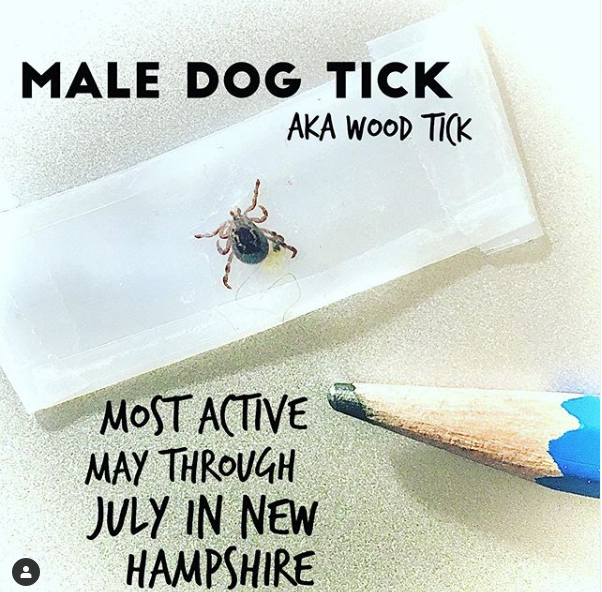
Pulled this beasty off me hubby today — oy!

Went to my website’s Tick Talk page, scrolled down to my first post “We found a tick; now what?” (May 5, 2019, below) and clicked on the link to Bebop Labs in New Hampshire to identify it & see what kind of diseases it may carry.

Best of my knowledge, it appears to be a male dog tick. Diseases listed on Bebop Labs’ site for this tick include:
  • Rocky Mountain Spotted Fever
  • Tularemia
  • Anaplasmosis
  • Human Monocytic Ehrilichiosis
  • Tick Paralysis
(More about each disease is on Bebop Labs’ website.)

Ticks are out--be safe! We also found a Black-Legged Tick (aka Deer Tick) nymph yesterday. It rode into the house upon our dog and crawled on my hand when I removed the dog's collar. I panicked and flushed the mini beast before recalling that I should capture it in tape & send it into Bebop Labs for data collection.

So what can you do to stay a bit safe outdoors?

Wear white or light colored pants tucked into white socks when you garden or hike, with a white or light long-sleeved shirt tucked into pants. The light colors allow you to more easily spot the dark ticks. Tucking in means the ticks can’t crawl inside your clothes. (Well, until they reach your collar. Or your sleeves if you’re not wearing gloves.)

Also, spray with Tick Ban or Dog Whisperer from YaYa Organics—all natural repellents that work brilliantly. Available at YaYa Organics' website, at Warner Public Market, many other local places, and yes, Amazon has them available too!
0 Comments

Fighting Mini Demons

2/3/2020

2 Comments

 
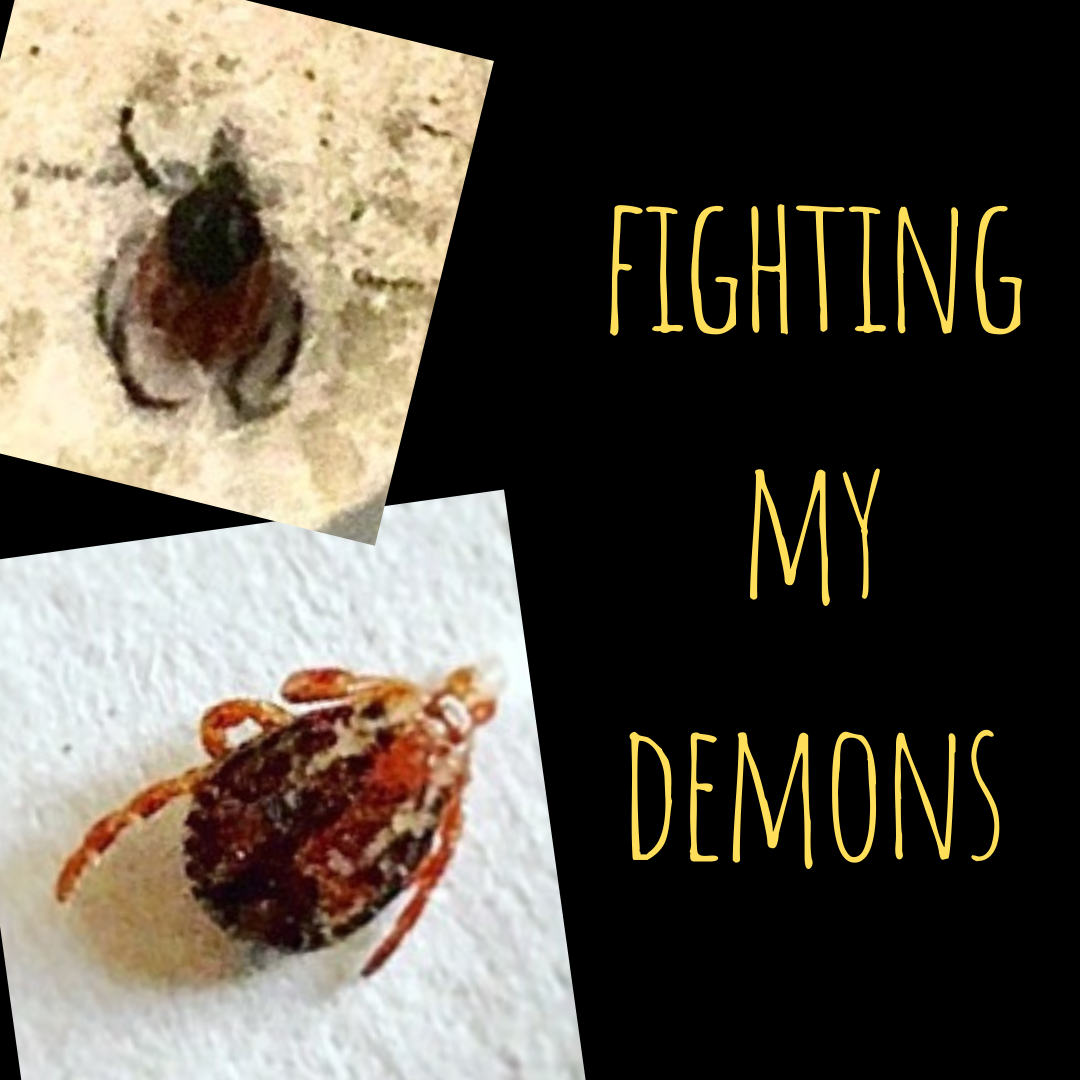
I'm a tick magnet...as evidenced by my having pulled yet another off my shin last week.

I can't seem to outrun them, even in what used to be the dead of winter. Now it's so crazy warm--relative to what it used to be--that the mini beasts known as ticks can not only survive, but they can thrive. And the blood thirsty demons can find my skin even beneath several layers of clothes. (It might be warm to them, but I'm still chilled when I walk in the snow.) 

And today I'm facing the oppression of mental battles unlike any I've seen in quite awhile. My emotional roller coaster is off the rails. From depression to anger to sorrow. As I type this, I'm in the holding pattern that is I-couldn't-care-less. At least it's grey inside my mind for the moment; believe me, it's better than the red of anger, the black of depression, or the deep blues of extreme sadness. 

I've added to my daily intake of tinctures and supplements. Am considering dipping into my antibiotic reserves too. The pain from Lyme arthritis is nothing compared to the emotional pain caused by Lyme and assorted co-infections. Perhaps I contracted Bartonella again. And my recent uptick in nosebleeds and easy bruising is a sign that my Babesiosis is flaring.

Who knows what that tick had inside her. I dropped her and lost her down the drain before I could tuck her in tape to send her to a lab for analysis. Oy. But as aggravating that is for me, I'm sure I'll soon have another opportunity to snag a tick for safe keeping.

I am a tick magnet, after all. 
Picture
2 Comments

When am I not writing?

1/16/2020

1 Comment

 
Picture
Writers write.

That could be the end of my blog post, but I feel a need to respond to my main character here. My main character who believes her author has not been writing for awhile. My main character who claims she is stuck smack dab in the middle of the trilogy that she and I are penning together.

Okay, well, I have no new pages this week. Today. This hour. But I have some new twists and turns in my head. I've been working through a huge surprise that she and I left on most recently, trying to make sense of it while mourning the death of a beloved character. 

That may be too much of a reveal, except that I've already told others that Anna and I were shocked when the body at the morgue was revealed. She was tasked with identifying the body. She did her job. But it really left her shaken.

She's also feeling quite alone. While she has her nephew who is driving her here and there, including to the morgue, her go-to peeps have been avoiding her since to hang out with Anna McGrory seems to often bring the threat of death.

But there. I've said enough, if not too much. What I'm really here to say is, "Hey, Anna, I'm here. I'm back. I'm writing. And it's going to be a very good year for us both. Even with all the trials we each face in our daily lives."

1 Comment

View or Listen to Our October Lyme Discussion

10/23/2019

0 Comments

 
View the Presentation
Picture
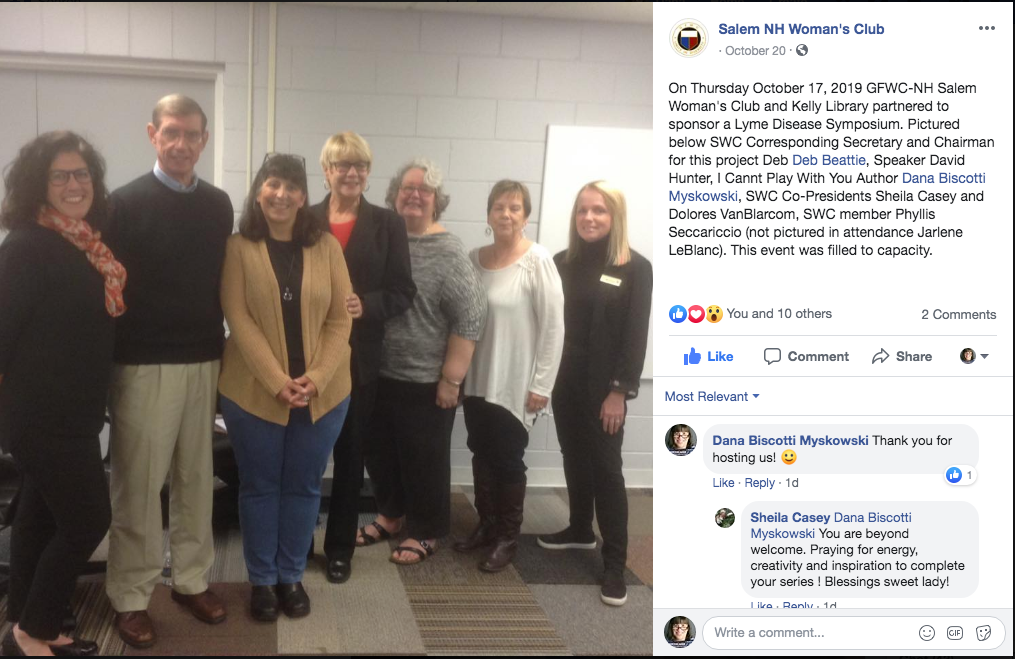
Thanks to the Salem, NH, Cable TV (SCTV) for videotaping the Lyme Disease Discussion that David Hunter and I led as part of the Kelley Library Adult Series (KLAS) presentations on October 17, 2019.

Hunter (pictured second from left above) is the chair of the Bedford, NH, Lyme Disease Council. I'm grateful to have been joined by him. If you attended the presentation or if you watch this webcast, you'll see how knowledgeable and helpful he is!

​Thank you to the Salem, NH, Lyme Disease Support Group, the Salem, NH, Women's Club, and the Kelley Library for sponsoring the event, and to the people who volunteered their time and talents to make it happen, pictured above, L-R: Deb Beattie, Hunter, skipping over myself next, Sheila Casey, Dolores VanBlarcom, Phyllis Seccariccio, and Betsy from the Kelley Library (also to Jarlene LeBlanc who was not pictured above, but who attended the discussion). 
0 Comments

New Hampshire Lyme Legislation

10/18/2019

4 Comments

 
A lively discussion at Salem, New Hampshire's Kelley Library on Thursday, October 17th, led to, among many other things, legislation.

David Hunter, Chair of the Bedford Lyme Disease Council, noted the 2011 passage of a bill to protect Lyme Literate Medical Doctors (LLMD) in the state from sanctions for operating outside the mandates and recommendations of the Centers for Disease Control (CDC), the American Medical Association (AMA) and its local New Hampshire Medical Association (NHMA), the Infectious Disease Society (IDSA), and the National Institutes of Health (NIH).

In so doing, our state joined a handful of others that have protected our LLMDs, which in turn has helped many patients get vital treatment for Chronic Lyme--a disease the CDC, AMA, NHMA, IDSA, and NIH still refuse to admit exists. 

A more recent New Hampshire legislative action, HB 490, put forth in 2019, calls for "...establishing a commission to study the role of clinical diagnosis and the limitations of serological diagnostic tests in determining the presence or absence of Lyme and other tick-borne diseases and available treatment protocols, and appropriate methods for educating physicians and the public about the inconclusive nature of prevailing test methods and available treatment alternatives."

Such a commission would include Representatives, a Senator, an AMA member who is also a member of IDSA, an LLMD certified by the International Lyme and Associated Diseases Society (ILADS), chronic Lyme patients, the state's epidemiologist (or designee), and more.

This broad committee would be free to discuss the reality facing thousands of Granite Staters who have suffered--or will in the future suffer--from tick bites that often lead to debilitating and confounding symptoms of Lyme disease and other tick-borne diseases.

While HB 490 passed the House, it stalled in the Senate. It is currently with the Senate's Health and Human Services Committee after having been tabled for the summer in the April 18, 2019 Senate session. No posting yet on when HB 490 will be brought to the Senate floor for a vote. If you are curious or want to let your senator know your preference for the bill's adoption, contact him or her, and perhaps reach out to the entire committee as well.
Who's my NH State Senator?
NH State Senate Health & Human Services Committee
HB 490 Text
4 Comments

Comments on Draft Lyme Disease Guidelines

8/8/2019

3 Comments

 
Read & Comment
With the looming deadline of Saturday, August 10 (UPDATE: Now extended to Monday, September 9th!) as the last day to submit comments to the Infectious Disease Society of America (IDSA), American Academy of Neurology (AAN), and the American College of Rheumatology (ACR) on the 2019 Draft Guidelines for the Prevention, Diagnosis, and Treatment of Lyme Disease, I thought I'd post six of my comments. Perhaps my obviously conspiracy-minded opinion will spur you on to submit your own observations and insights.

Feel free to comment on my blog too, but please be polite. Judge not until you've walked a mile in my shoes. That's saying something, since I cannot everyday walk a full mile as I juggle my on-going symptoms of Lyme, Bartonella, Babesia, and the lingering effects of the Powassan Virus.

.
ONE) First, I will agree with the Research Needs evaluation of Chronic Lyme: That further studies need to be done. But in reference to line 1495 (and 1496) I wish that more of an effort would be made to understand that many of us in the Lyme literate world recognize Chronic Lyme as being a case of Lyme that has gone misdiagnosed and/or undiagnosed, often for years, and that the language in these lines "...prolonged antimicrobial therapy is not helpful" actually hurts a huge number of patients who, like myself, have found that once Lyme was identified as being the root of my clinical problems (fibromyalgia, nerve damage, brain fog, chronic fatigue, interstitial cystitis, possible lupus, arthritis at a young age, sudden onset of severe food intolerances, and more)--after being treated for more than a year (nearly 18 months) on antibiotic cocktails, plus with periods of pulse antibiotics--my symptoms disappeared. Until I was reinfected over and over again. And each time treatment works to reverse the crazy debilitating symptoms INCLUDING depression. Furthermore, I am not a one-off. My Lyme-literate physician has treated hundreds of us with the same results, even if we don't all share the exact same misdiagnoses or symptoms. Prolonged and varied exposure to antibiotics saved my life. When I was struggling to get from the sofa to the bathroom--and given four to six weeks to live in my mid-forties--my Lyme-literate physician saved my life by treating me for the UNDERLYING CAUSE...let me repeat that in case you didn't read it correctly...he treated me for the UNDERLYING CAUSE of all my misdiagnoses and illnesses, and cured my fibro, much of my nerve damage, most of my brain fog and chronic fatigue, my interstitial cystitis, Lyme arthritis, severe food allergies (inability to breathe if I ate certain foods), and even my depression and anxiety. So, I will return to my agreement with the Research Needs findings: MORE UNBIASED RESEARCH NEEDS TO OCCUR IN THE AREA OF CHRONIC LYME.  
.     
TWO) Please make these "...two most commonly identified coinfections" more common knowledge to physicians, health professionals, and patients. That is: Anaplasma and Babesia, both of which I have fought twice in my five times dealing with being re-infected with Lyme. The first time I had Babesia I thought I was going to die. It was soon after my urologist had informed me that I had perhaps four to six weeks to live, and another urologist announced that only surgically removing my bladder would heal me. I went running from both physicians. Fortunately, an astute physician assistant recognized my years of accumulated symptoms and diagnoses as being most probably a missed Lyme diagnosis since the test is so pathetically weak at identifying most strains of Lyme. Soon after being treated for my CHRONIC Lyme, I became an all-new-level of ill; I was diagnosed with Babesia, but it was late for me, and I was so sick I was certain my exhausted body and compromised immune system would not survive. Obviously, I did survive, or else I wouldn't be irritating you with my comments now.
.   
THREE) As to Bartonella, the line beginning at 1563 and winding to 1564*, seems ill researched. I want more research into this and, again, more dialogue with physicians and health providers so that they at least look for Bartonella too, among their deep dive into what is making their patients so sick. I have been diagnosed with Bartonella three times. I am not alone. I could make a large enough club of Bartonella and Lyme members to elect me president if I decided to run. Okay, perhaps that is hyperbolic, but not by much. I think you know that too, but for some reason you don't want the medical community or patients to know.
* "While I. scapularis may take blood meals from animals infected with Bartonella species, transmission to humans has not been identified.” 
.   
FOUR) Regarding Research Needs that states "further studies determining the frequency of I. scapularis-transmitted co-infections in different geographic areas of the U.S. are warranted" I agree. I also agree that "Further investigations are needed to study the cost-effectiveness of multiplex laboratory assays for the simultaneous diagnosis of multiple coinfections." And I would go one step further in saying that a study into the cost-effectiveness and reliability-effectiveness of laboratory testing for Lyme needs to be further researched, and testing needs to be expanded to identify all strains of Lyme disease.
.     
​FIVE) There are 100 pages here and 203 pages in the supplement, and a deadline for comments by August 10. I have two complaints to register:
1) The reports are too long for most Lyme patients to even skim, never mind read carefully.
2) For some reason your organization feels compelled to warn: "Draft - Do Not Distribute," which completely negates the opportunity to spread the word about the draft and to get others to take the time to comment. 

Do you or do you not want people to comment? I believe you do not. 

In fact, I believe you want to play the part of the martyr who gets to say, "But we put the drafts out for open comment, and only X number of people actually took the time to do so. If there are so many Lyme patients out there in the world, we have no evidence of it."

My recommendation is to find area reps who can field focus group-style comments from caregivers, physicians, nurses, patients, holistic caregivers, family and friends of Lyme patients, etc., to pull together fact and anecdotal reports, plus gather and organize the comments and recommendations. If you took the time to do this correctly, you would actually represent the entire community--including the International Lyme and Associated Diseases Society (ILADS).

If you will endeavor to do such good work, I will offer to put aside my third Lyme conspiracy novel and help you as a representative in my area of Central New Hampshire. Thank you.
.   
SIX) The table has no number, so just go to the page to see what I am referring to, please.

In the top of the table, under the subheading "Certainty assessment," three columns in is the listing "Risk of bias."

I believe your own bias negates the findings as to serious or not serious in each section citing a study. The reason I believe your bias overshadows everything in both this supplemental report and in the overall report is that the use of antibiotics to treat so many misdiagnoses, which have in common the underlying CAUSE of Lyme bacteria, actually would lose money for the pharmaceutical companies and for many physicians and other caregivers who are opting to surgically remove bladders, ordering CT Scans and MRIs, prescribing expensive drugs to treat one ailment--potentially creating a cascading event of other ailments.

The entire medical field, the government-supported medical groups and organizations, are compromised by the pharmaceutical and medical lobbyists who pay to keep their drugs and expensive medical procedures active, while discounting the use of relatively inexpensive antibiotics. After all, if someone has ALS, which potentially can be treated with antibiotics, it would put many of the medical providers and drug manufacturers out of business. ​

It is time to clean house, and to make sure that no seriously biased individuals or groups have a seat at any table where national Lyme Disease Guidelines are being formed. 
  
Please join me in leaving your comments on the Lyme Disease Guidelines. Follow the link above or below! 
Read & Comment, even if it's only on one section.
3 Comments

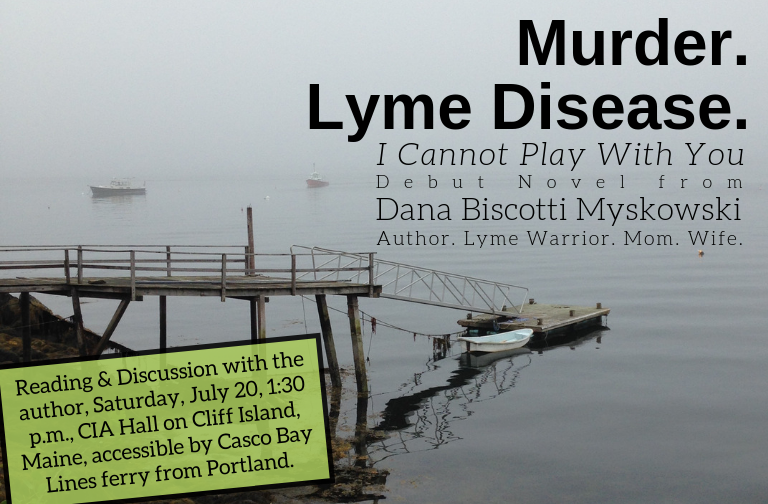
Dana to speak at the Cliff Island Association Hall as part of a Cliff Island Library Program, Saturday, July 20 at 1:30. Join the free event by Casco Bay Lines Ferry, water taxi, or your own boat!

7/9/2019

1 Comment

 
Picture
​What do you do when your journey down the rabbit hole that is Lyme disease likely began with a misdiagnosis of ringworm, led to a possibility of advanced bladder cancer, morphed into several autoimmune disorders that required visits to a myriad of medical personnel, and finally, nearly a decade later, was correctly diagnosed as Lyme?
  
Perhaps, like many, you write a memoir.
  
Or you turn to the wisdom of Albert Camus and tell your story in a novel since, "Fiction is the lie through which we tell the truth."
  
Author, screenwriter, and regionally Emmy-nominated producer Dana Biscotti Myskowski has given her 50-year-old protagonist, Anna McGrory, a state director for a U.S. Senator from the Berkshires of Massachusetts, all of the exhausting, perplexing, and often painful symptoms of her own Lyme disease and its co-infections.
  
“When her beloved senator boss winds up dead, even Lyme disease can’t stop Anna McGrory from becoming a self-proclaimed Nancy Drew. With more twists and turns than the Mohawk Trail, I Cannot Play With You is suspenseful, surprising, and a total page-turner,” writes Hilary Weisman Graham, TV writer for Orange is the New Black and Bones, and author of Reunited from Simon & Schuster.
  
Anna travels from her home in Concord, New Hampshire, to the Berkshires of Western Massachusetts, into Boston, and up to the islands off the coast of Portland, Maine, in this tale of intrigue. The story, which begins and ends on idyllic Cliff Island, Maine, features favorite local businesses such as Casco Bay Lines in Portland and Angelina’s Ristorante Italiano in Concord.
  
​Cultural attractions also appear, including MASS MoCA and the Boston Symphony Orchestra, which are spotlighted in end-of-chapter summaries with links to Anna McGrory’s Pinterest pages. Also featured is the Cliff Island Stone Library, as well as the Trustees of Reservations’ Field Farm in Williamstown, Massachusetts, which serves as the fictional U.S. Senator’s home.
  
The author has been speaking with audiences at New Hampshire bookstores and libraries, occasionally joined by Lyme Literate Medical Doctor Lynn Durand of Family Tree Healthcare in Concord, NH. She also joined the Fifth Annual Midcoast Lyme Disease Support and Education Conference in Augusta, Maine in April. Her speaking schedule extends through October as she continues work on her second book in the Lyme disease murder mystery series.  
  
I Cannot Play With You, released in December 2018 by Texas publisher Black Rose Writing, is available at Sherman’s Maine Coast Book Shops, the Cliff Island Store & Café, MainStreet BookEnds in Warner, New Hampshire, and online at Amazon, Barnes & Noble, and via Indigo/Chapters in Canada. For more information, please surf the author’s website while you're here.
Ferry
Stone Library
Store & Cafe

I Cannot Play With You, which begins & ends on Cliff Island, features a protagonist juggling an assortment of confusing Lyme disease symptoms as she finds herself becoming an amateur sleuth following the apparent suicide of her U.S. Senator boss.

1 Comment

We found a tick; now what?

5/5/2019

0 Comments

 
Don't panic. Many of us have been there, and it feels scary with all the conflicting information contained in the interwebs. Let's begin with this checklist:
  1. Was it embedded on you or crawling?
  2. Was it engorged?
  3. Were you able to remove it in one piece?
  4. There are controversies on how to remove it; I've posted a video to the right via the Lyme Disease Association, Inc.  (I prefer to use a little tick removal tool that looks like a garden hoe with a V shape cut into it, which I bought at my local feed store.)  

Next, I would call my doctor. Perhaps he or she will want to see you and the tick in question. If it is identified as a black-legged tick (Ixodes scapularis), your physician may suggest a course of antibiotics as a precautionary measure to help prevent Lyme disease, or at least nip it in the bud.

We also discussed sending off the tick to a laboratory for testing. Labs can identify the type of tick, what stage of growth it is in, whether it is male and female, and--for a fee--even report on whether it had any of the numerous tick-borne diseases, including Lyme. Links to a few New England-area labs are to the right.
Tick Report, UMASS Amherst
Bebop Labs, Ashland, NH
Tick Lab, U of Maine (Maine Residents)
NOTE: At the time of this posting (May 5, 2019), Costs for TickReport = $50 (it also offers an app with a FREE tick identification feature); for Bebop Labs = $35 (information on the downloadable .pdf), and for Tick Lab at U Maine = $15 (only available to Maine residents). If you have a favorite tick identification lab, feel free to contact me so I can add it to the list. Thank you!
0 Comments

    Author

    Lyme Warrior. Mom. Wife.

    Archives

    April 2020
    February 2020
    January 2020
    October 2019
    August 2019
    July 2019
    May 2019

    Categories

    All

    RSS Feed

Picture
Read the multiple award-winning script.
Picture
EMMY-nominated PSA
Picture
Follow on Instagram @biscottidana
Picture
Contact
  • NonaDana